


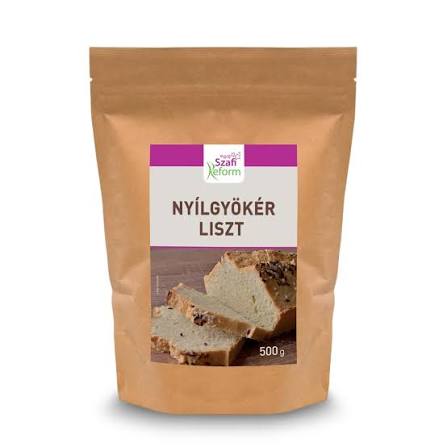

Arrowroot flour is ideal for thickening sauces, soups, gravies, puddings and creams, as well as for baking bread, cakes and biscuits. It is an excellent alternative to both wheat flour and cornflour.
Why choose it?
- 100 % natural raw material
- Gluten-free
- Neutral flavour
- A delicate, silky texture
- It thickens dishes very well
- A substitute for both wheat flour and maize starch
- Resistant to acidic ingredients (e.g. lemon juice, apple cider vinegar)
- It does not change its consistency after freezing
What is arrowroot flour?
Maranta (arrowroot) has been cultivated for over 7,000 years. The flour is made from the underground tubers of this tropical plant, which is native to the Caribbean and South America.
It has a pale white colour, a powdery texture and a neutral taste, making it a versatile ingredient in the kitchen.
Usage
Suitable for thickening:
- sauces,
- side dishes,
- soups,
- puddings,
- creams,
- fruit jellies.
It’s also ideal for preparing:
- gluten-free baked goods,
- paleo bread,
- muffins,
- biscuits,
- sponge cakes and other desserts.
Substitutes in recipes
- 2 teaspoons of arrowroot flour = approximately 1 tablespoon of cornflour
- 1 teaspoon of arrowroot flour = approximately 1 tablespoon of wheat flour
Advantages over tapioca starch
- It copes better with acidic ingredients such as lemon juice or apple cider vinegar.
- Baked goods made from arrowroot flour can be frozen without any problem and without any change in texture.
Who is it suitable for?
Recommended:
- when following a gluten-free diet,
- for fans of the paleo diet,
- Anyone looking for a natural thickener or an alternative to ordinary flour.
Composition
100 % arrowroot flour.
Allergens
May contain traces of sesame, mustard, celery, nuts, and sulphites.
Nutritional information (per 100 g)
- Energy: 1481 kJ / 348 kcal
- Fats 0 g
- of which saturated fatty acids: 0 g
- Carbohydrates 86.9 g
- of which sugars 0,1 g
- Fibre 0 g
- Proteins 0.2 g
- Salt 0.07 g


Reviews
There are no reviews yet.